Stage Holograms
Large-Scale Holographic Productions
Create unforgettable moments with lifesize holographic performers, virtual keynote speakers, and legendary figures brought back to life on stage. For close-range, walk-up holographic engagement, see Holobox; for the full visual stage, pair with 3D projection mapping.
Holographic Stage Capabilities
World-class stage hologram production
Lifesize Holograms
Full-scale holographic performers that appear to be physically present on stage.
Live Performance Sync
Holograms synchronized with live musicians, dancers, and speakers.
Virtual Keynotes
Speakers appear holographically at events without physical travel.
Celebrity Resurrections
Bring historical figures and legendary performers back to the stage.
Live Interaction
Real-time holographic communication between locations.
Custom Content
Professional capture and animation of holographic content.
Our Process
From concept to showtime
Concept
Design the holographic experience
Capture
Record or animate holographic content
Stage Setup
Install projection and display systems
Showtime
Deliver the magical performance
Perfect For
Where stage holograms make the biggest impact
Concerts & Tours
Holographic performances that wow audiences at music venues worldwide.
Award Shows
Stunning holographic appearances at galas and award ceremonies.
Corporate Events
Keynotes and product launches with holographic presenters.
Theater Productions
Integrate holographic characters into live theatrical performances.
Global Broadcasts
Speakers appear holographically at multiple locations simultaneously.
TV & Film
Holographic effects for broadcasts, commercials, and productions.
Technical Capabilities
Professional stage hologram systems
Related Case Studies
Projects we have delivered for clients across the UAE
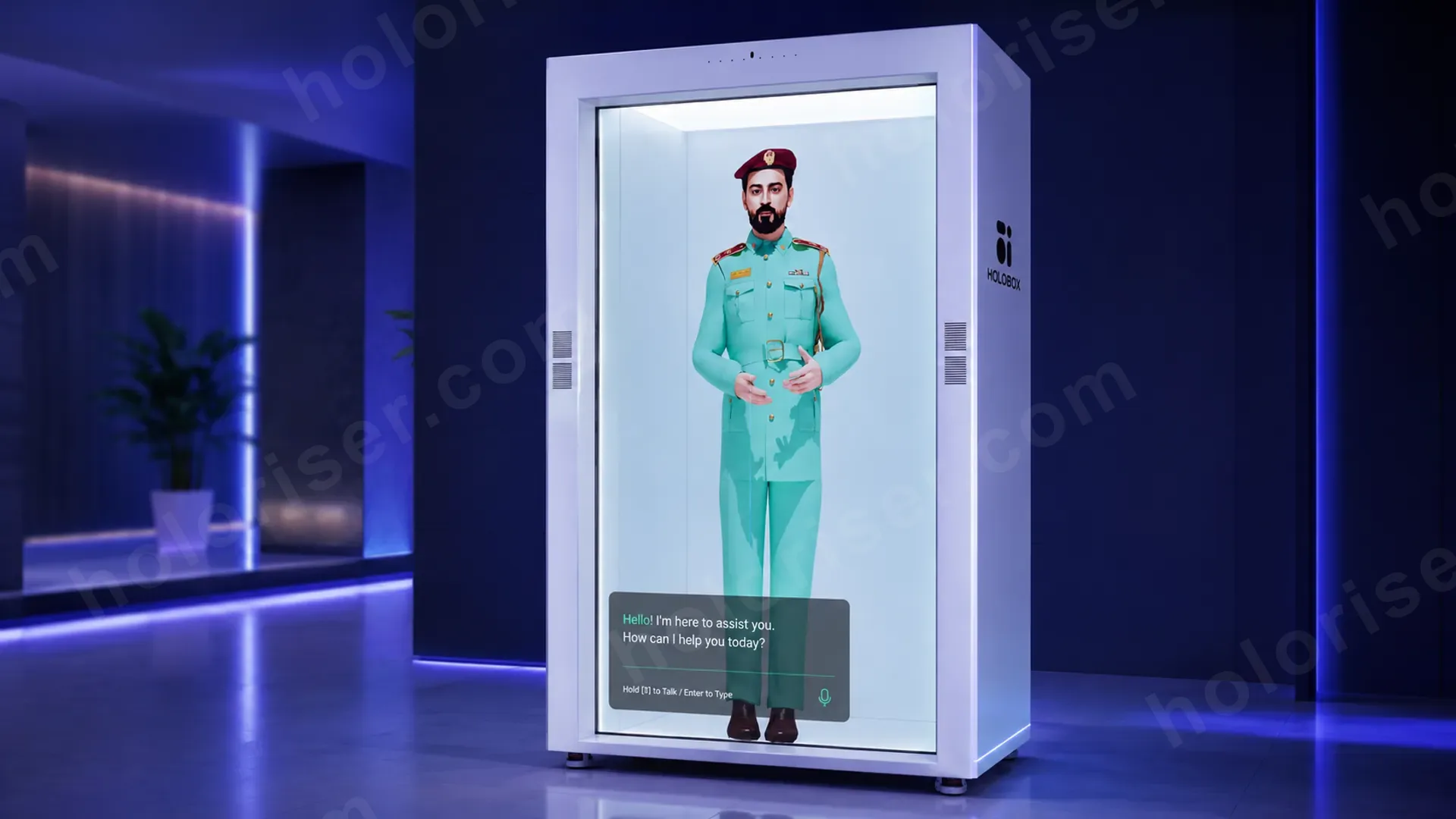
Interactive Virtual Policeman
A realistic Emirati police officer, AI-powered and shown on a 75" Holobox, that listens, talks and answers visitor questions while pulling data from custom back-end systems.
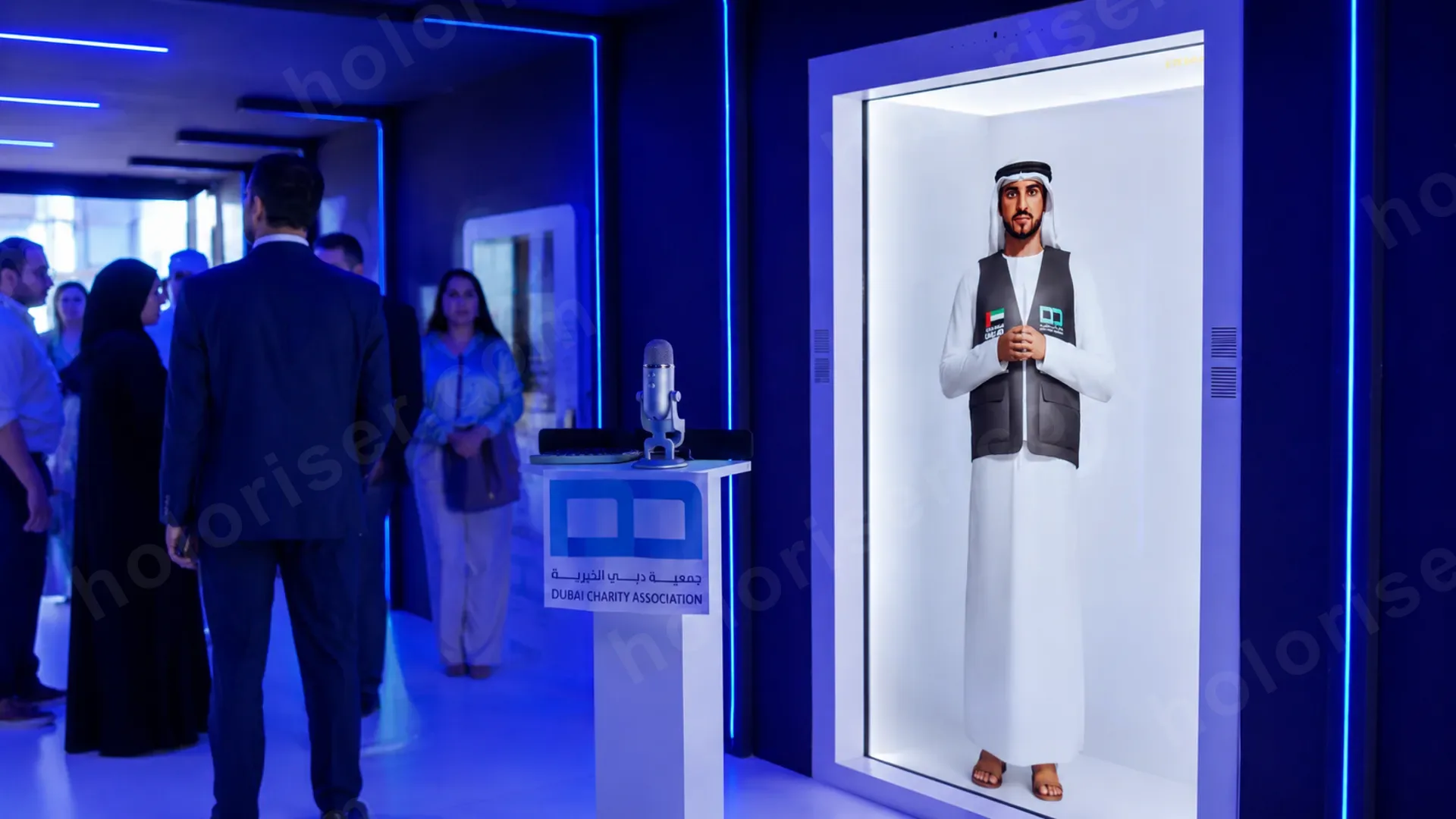
Ahmed — AI Smart Assistant
Ahmed is a 3D AI assistant with Emirati features, shown on a 75" Holobox. Built on a RAG system, he answers visitor questions about the association from approved data, in Arabic, English and Hindi.
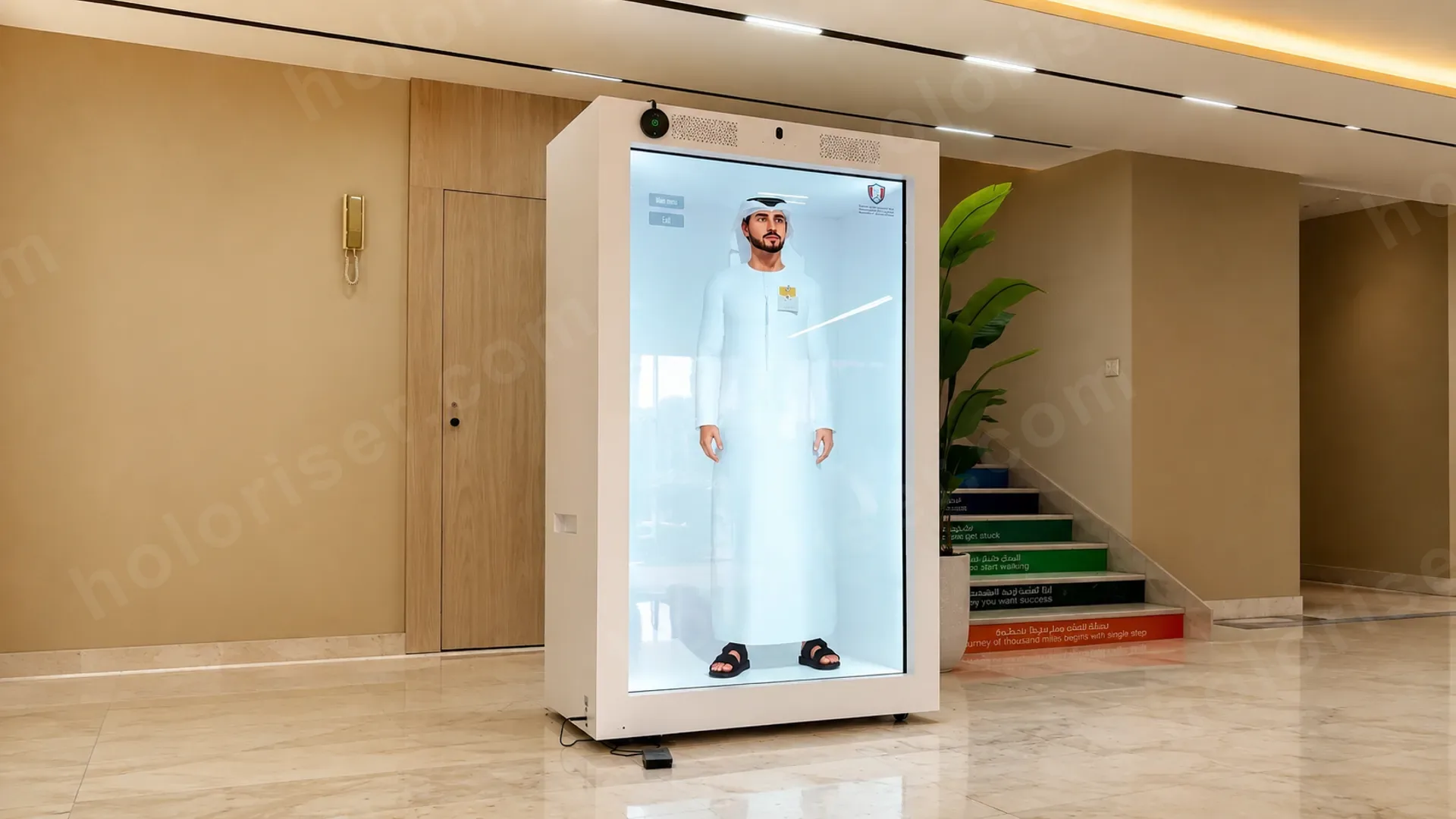
Hamad — HR Smart Assistant
Hamad is an AI-powered Emirati character on a 75" Holobox for Fujairah Human Resources. He answers visitor and staff questions about HR services through direct voice conversation.
Frequently Asked Questions
Common questions we get from clients
How does a stage hologram actually work?
Most large stage holograms use the Pepper's Ghost technique: a high-brightness display reflects off a tilted transparent foil so the image appears to float on stage. Newer setups use transparent LED screens. In both cases, the audience sees a life-size figure that looks present, but there's no actual 3D image floating in mid-air — the optics do the trick.
Can a hologram interact with live performers?
Yes. The hologram can be choreographed to specific cues, share the stage with dancers and musicians, and react to lighting and music changes. With live holographic telepresence, a real person in another location can also "appear" on stage in real time and have a conversation with someone physically there.
Do you support live holographic telepresence?
We do. It needs a controlled capture studio at the source, a stable connection (we plan around the latency), and the receiving stage rigged for hologram playback. It works well for keynotes where the speaker can't travel, panel discussions across cities, and award appearances. Pre-recorded content is more forgiving and is what most events end up using.
How big can a stage hologram be?
Standard setups go up to about 6 meters wide and 3 meters tall, which is enough for a full-band performance. For arenas we can go larger using multiple stacked panels or transparent LED. The practical limit is the stage geometry and the viewing angles you need to cover.
Can we use a holographic version of a deceased performer?
Technically yes, and there are well-known cases. Practically, this is a rights and ethics conversation first: estate clearance, performance rights, and a clear creative reason. We help with the production side, but we won't take on a project unless the rights chain is clean.
What space and lighting requirements are there?
The stage area for the foil or transparent screen is typically 8–12 meters deep including masking. The key constraint is lighting: stray light hitting the reflective surface kills the illusion, so the front stage area needs careful lighting design. We always do a pre-show site visit and adapt the lighting plot.
How is this different from a Holobox?
A Holobox is a self-contained transparent unit (around 50 cm × 222 cm) for close-range engagement. A stage hologram is a custom-built large-scale setup for an audience. Same family of optics, very different scale and use case. Some clients use both: stage hologram for the main show, Holobox at the entrance and VIP areas.
Ready to bring holograms to your stage?
Let's create magical holographic performances.