What a Facade Projection Mapping Quote in Dubai Actually Buys You
Survey, surface, lumens, rigging, power and content time. A plain breakdown of where the money goes when you put a projection mapping show on a building in Dubai.
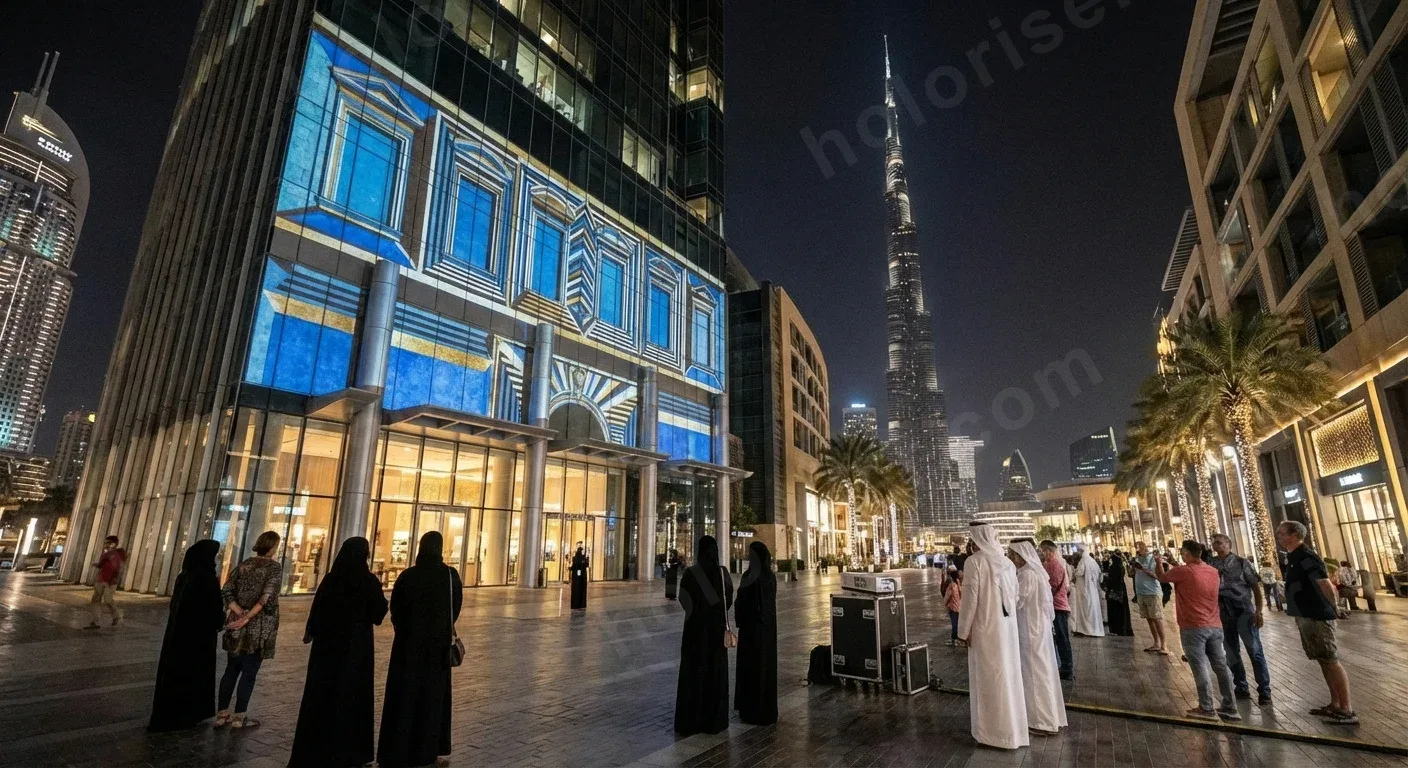
The quote arrives as one number with five words attached: design, content, equipment, install, operate. Then somebody compares it to the price of an LED wall for a week and asks why two minutes of video on the side of a building costs more.
Fair question, and the answer is not in the video. Most of a facade projection mapping budget goes on things that never appear in the show reel: a survey, a projector position you had to negotiate for, and six weeks of animation work that only matters on one night.
Here is what sits under each line.
The survey comes before anyone opens the animation software
We do not build from the architect's drawings. Drawings describe the building as designed. The building as built has an AC unit bolted to the fourth floor, a signage box nobody documented, a balcony rail that sits further out than the plan claims, and a service door that moved during fit-out.
So the job starts with a site survey: a laser scan or a photogrammetry pass over the facade, plus reference photography taken from the exact spot the projectors will occupy on show night. That last detail surprises clients. A scan model is accurate from every angle. The show only has to be accurate from one, and it is the projector's, not the architect's.
Everything downstream inherits that survey. If the model is loose by a few centimetres, every content revision carries the same error, and you find out on the test night when the cracking-glass effect breaks 30 centimetres to the left of the actual glass. Re-aligning content two days before a launch is where projects lose money.
Your facade sets the brightness ceiling before you buy a single projector
A projector adds light. It cannot subtract light. There is no black in projection mapping. Black is the part of the frame where we send nothing and let the building be the building.
What the surface does with the light you do send decides the rest. Pale matte surfaces are the easy case: sand-coloured stone, white render, painted concrete, most plaster finishes. They return most of what hits them and hold colour. A lot of the low-rise stock across Dubai, Sharjah, Ajman and Fujairah sits in that bracket, which is why a modest rig can look expensive on the right building.
Glass is the hard case. A curtain-wall tower behaves like a mirror: the beam arrives, bounces off at the opposite angle, and carries on into the sky above the crowd. Dark cladding fails differently. It absorbs, so doubling the projector power does not double what the audience sees.
If the facade is mostly glazed, the choice narrows to two: hang a temporary scrim, or design the content to live on the solid piers between the glazing. When neither works, the idea moves indoors, where exhibition and event visual setups do the job the facade could not. Somebody should tell you this at survey stage, not after you sign.
Distance decides the projector count, not the size of the building
Two numbers drive the equipment list: how far back each projector has to stand, and how much area it has to cover.
Light falls off with distance. Push a projector twice as far from the wall and roughly a quarter of the light reaches each square metre. On a real job the position is rarely a free choice. There is a road, a car park boundary, a neighbouring plot with its own security, and a permit that says where equipment may and may not go. Whatever position survives that process sets the throw distance, and the throw distance sets the lumens you need.
That is where stacking comes in. When one machine cannot reach the required brightness from the available distance, you converge two or four of them on the same zone, aligned to the pixel, so their output adds. Wide facades then get split into overlapping zones with the seams blended, so the audience sees one image instead of tile boundaries.
The honest answer to "how many projectors" is therefore: nobody knows until they have stood on the site after dark. Any quote written before that visit has a safety margin baked into it.
Showtime after dark is not a preference
Ambient light competes directly with the show. The sun is the obvious problem, but inside a city the more annoying sources are local: the building's own architectural lighting, the streetlights, an LED billboard across the road, the hotel next door.
Half the work on a Dubai facade is negotiating those off. Building management can usually kill the architectural lighting for the run of the show, and that single change does more for contrast than another pair of projectors. Neighbours are harder. Sometimes you accept the spill and design the content brighter and higher in contrast so it survives.
Practically, that puts showtime after sunset, with the strongest look an hour or more later. Build the run of show around that, not around when the VIPs finish dinner.
Power, rigging and the things that go wrong at 2am
Projector positions need clean power and somewhere safe to stand. On most sites that means a silent generator and a distribution board, with cable runs short enough to avoid voltage drop. Then the physical position: a scaffold tower, a ballasted truss, a roof with the owner's written permission, or a first-floor terrace you rent from a neighbour.
Wind moves structures. A tower that shifts a few millimetres in a gust shifts the image several centimetres on a facade 80 metres away, and the audience reads that as the whole building wobbling. Ballast, bracing, a hard wind-speed limit and somebody watching the forecast are all part of the job. Dust and summer humidity affect the optics too, so lens cleaning and filter checks go into the nightly routine.
None of this appears in the concept video. All of it appears in the quote.
Content is the long pole; install is the short one
Here is the split that surprises most marketing leads. Animation usually runs six to eight weeks from brief to final render. Install and alignment is usually two nights.
Content takes that long because it is built against your specific geometry, then reviewed, revised and re-rendered. Custom character and asset work runs on the same clock. When we produced the bilingual quiz host for Fujairah Digital Government at GITEX 2025, the character build and programming ran for weeks before anyone touched the stand. For the Bride Show in Abu Dhabi we prepared more than 80 products as 3D models and 360-degree captures, and that asset pipeline, not the display, set the schedule.
The working rule: every extra approval round costs about a week. If four people need to sign off the storyboard, settle who has the final word before the storyboard exists.
How to read the quote
Ask for these as separate lines and the number stops looking arbitrary:
- Survey and 3D model of the facade
- Content production, with the number of revision rounds stated
- Projectors, by count and by zone, with the stacking explained
- Media servers, control and edge blending
- Structures, power and cabling
- Crew for install, test night, show nights and de-rig
- Permits and on-site coordination
If content and equipment are bundled into one figure, you cannot tell whether you are paying for animation or for hardware, and you cannot value-engineer either.
Facade mapping is a strong format when the building suits it and the timeline is real. It is a weak one when the surface fights you and the content has three weeks. If you have a building and a date, send us the address and the date and we will tell you which of the two you are in.