AI Hologram Assistant for UAE Service Centres: How It Works
How an AI hologram assistant handles queues, repeated questions, languages and handover to staff in UAE service centres and receptions.
Ask the staff at a UAE service-centre counter what fills their day, and it is rarely the complicated cases. It is the same twenty questions, in five languages, from people who have stood in the wrong queue for fifteen minutes. Which documents do I need? Is this the right building? Can I do this online? Where do I pay?
That is the job an AI hologram assistant is good at: not replacing the counter, but taking the repeated questions off it, so staff can spend their time on the cases that need a person.
This post is about receptions, service centres and front desks. For how the character itself is built, read how an AI hologram avatar is built. For event stands and awareness campaigns, see how UAE government entities use holographic presenters.
What an AI hologram assistant actually is
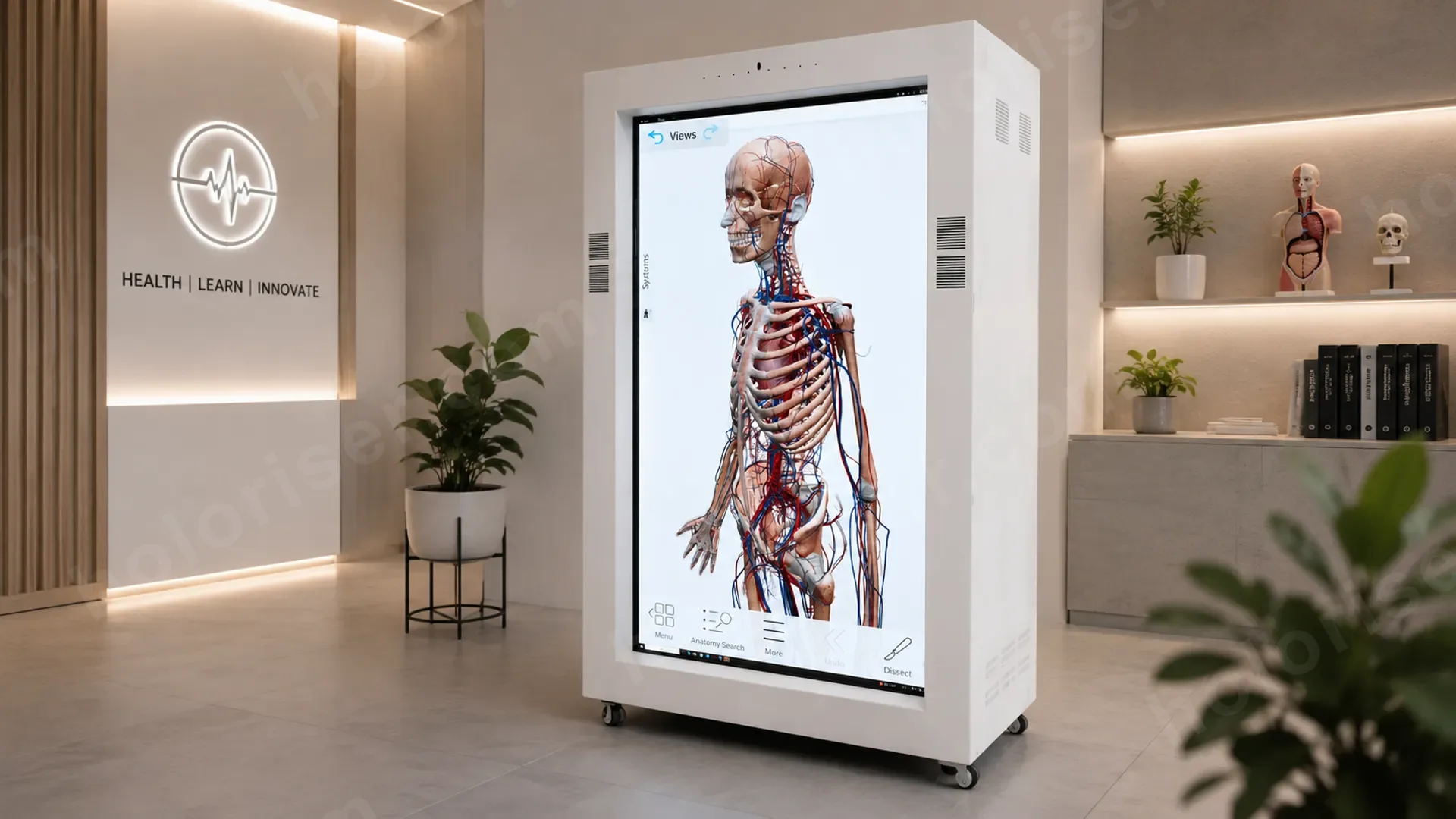
It has three parts. A Holobox, the display, in 65", 75" or 86", which shows a character at roughly human size and works in a normally lit lobby. A 3D character, either designed or based on a real member of staff. And the AI behind it, which listens to the visitor, finds the answer in content your organisation has approved, and replies by voice in the visitor's language.
That last point matters most in a service centre. The assistant does not answer from general internet knowledge. It answers from your service guides, your FAQs and your policies, and when the answer isn't there, it says so and points the visitor to a person. A digital employee that improvises is a liability. One that knows its limits is useful.
Where it helps in a service centre
The questions before the queue
Much of what clogs a counter happens before the transaction: am I in the right place, what do I need to bring, which service is this? An assistant at the entrance answers those in the first minute, so a visitor missing a document finds out before taking a ticket, not after twenty minutes of waiting.
Languages the counter can't cover
The UAE is home to more than 200 nationalities, according to the Ministry of Foreign Affairs. No front desk can staff every language.
This is where our projects make the case best. Ahmed, the AI assistant we built for Dubai Charity Association on a 75" Holobox, answers visitors' questions about the association in Arabic, English and Hindi, from the association's approved sources. Khalid, built for the Ministry of Justice in Abu Dhabi on an 86" Holobox, explains workers' rights in Arabic, English, Hindi and Urdu, because that audience is not bilingual. Choose languages from the people who actually walk in, not from a list of what is possible.
Guided journeys, not only answers
Some service points need more than Q&A. Hareb, the character we built for the UAE Red Crescent, welcomes the visitor, explains the donation channels, walks them through the payment steps on the device and thanks them at the end. Khalid's interface carries direct buttons to start a report or reach the relevant service, so a worker can begin a real process at the device instead of being told where to go next. For a reception desk, the equivalent might be booking an appointment, checking what a service needs, or showing the way to the right counter.
The same message, said patiently every time
Mozzah, the character we built for Fujairah Environment Authority, answers questions about the authority's work in Arabic and English, the kind of content a receptionist repeats all day. For Dubai Police we built an awareness quiz around a virtual policewoman that runs self-serve, from the welcome to the score, with no staff member needed beside it. Either way, the hundredth visitor hears the message exactly as the first did.
Quiet hours and after-hours
A lobby that is open when the counters are not, or a reception with one person covering lunch, is a natural place for an assistant. It answers the routine questions and points visitors to the opening hours and the online alternative. It won't process a transaction it isn't connected to, and shouldn't pretend to.
Handing over to a human
This is the part to design first, not last. Every assistant needs clear rules for when it stops and a person takes over: a complaint, a sensitive personal case, a question outside the approved content, or a visitor who simply wants a human.
There are two ways to do the handover. The assistant can direct the visitor to a named counter or call a member of staff. Or the Holobox can switch from the AI character to a live employee who appears at life size and talks with the visitor two-way from another office. That second option lets one specialist cover several branches without travelling.
The public sector is moving the same way. At GITEX Global 2025, Abu Dhabi presented TAMM Hologram, pods that connect residents to a live government agent in Arabic and English, with a plan to roll them out across the emirate. AI for the repeated questions and a person for the rest is a sensible split.
Content approval: who signs off
In a service centre, a wrong answer sends someone to the wrong place with the wrong documents. So the content needs an owner.
Before launch, agree on three things: the approved sources the assistant answers from, the topics it declines, and the exact words it uses when it doesn't know. For Fujairah Digital Government at GITEX 2025 we built an admin side where the entity's own staff added, edited and approved content before it reached the public, and nothing went live without sign-off. A service centre needs the same discipline, plus a routine for updating the content whenever a fee, a form or a procedure changes.
What data the centre gets back
An assistant also tells you what your visitors are asking. Depending on what you agree, it can report the most common questions, the questions it couldn't answer, the languages used and the busiest hours. The unanswered list is the most valuable: it is a running audit of what your website, signage and FAQs are missing.
Decide early what is logged and what isn't. Anonymous question logs are usually enough for this.
Privacy and visitor data
Treat the assistant like any other system that touches visitors. The UAE's personal data protection law (Federal Decree-Law No. 45 of 2021) sets rules on how personal data is processed, and government entities and free-zone organisations often have their own data policies on top. Settle these questions with your legal and IT teams before the build:
- Does the assistant need any personal data at all, or can it answer without it?
- If it records audio or transcripts, where are they stored, for how long, and who can see them?
- Is there a clear notice at the device telling visitors what is collected?
- If it connects to your systems, what security review does that integration need?
The simplest assistants collect nothing personal. Add data only when a service genuinely needs it.
Is it the right fit for your centre?
An AI hologram assistant earns its place when the same questions arrive every day, the visitors speak more languages than the staff, and there is a clear owner for the content. It is a weaker fit if most visits need identity checks or judgement from the first minute, or if nobody will keep the content up to date.
The UAE's national AI strategy, approved by the Cabinet in 2019, names customer services as one of the areas where AI should improve people's lives. A reception assistant is one of the most visible ways to do that.
See our AI hologram assistant service, our options for a hologram in Dubai and the full set of case studies. If you run a service centre or reception, tell us your most common questions and your visitors' languages, and we will show you a live demo of an assistant answering them.