Holograms in Education in the UAE: Museums, Universities and Medical Training
How UAE museums, universities and medical trainers use Holobox holograms and VR: 3D anatomy, multilingual AI guides and live remote lecturers.
When an education client contacts us, the brief rarely starts with technology. It starts with a problem: students struggle to picture an organ from a flat diagram, a gallery has more visitors than guides, or the best lecturer for a topic lives in another city. A hologram display or a VR headset only earns its place if it solves one of those.
This guide covers how hologram education in the UAE actually works in three settings, museums, universities and medical training, what the research says, and when VR is the better tool.
What does a "hologram" mean in a classroom or gallery?
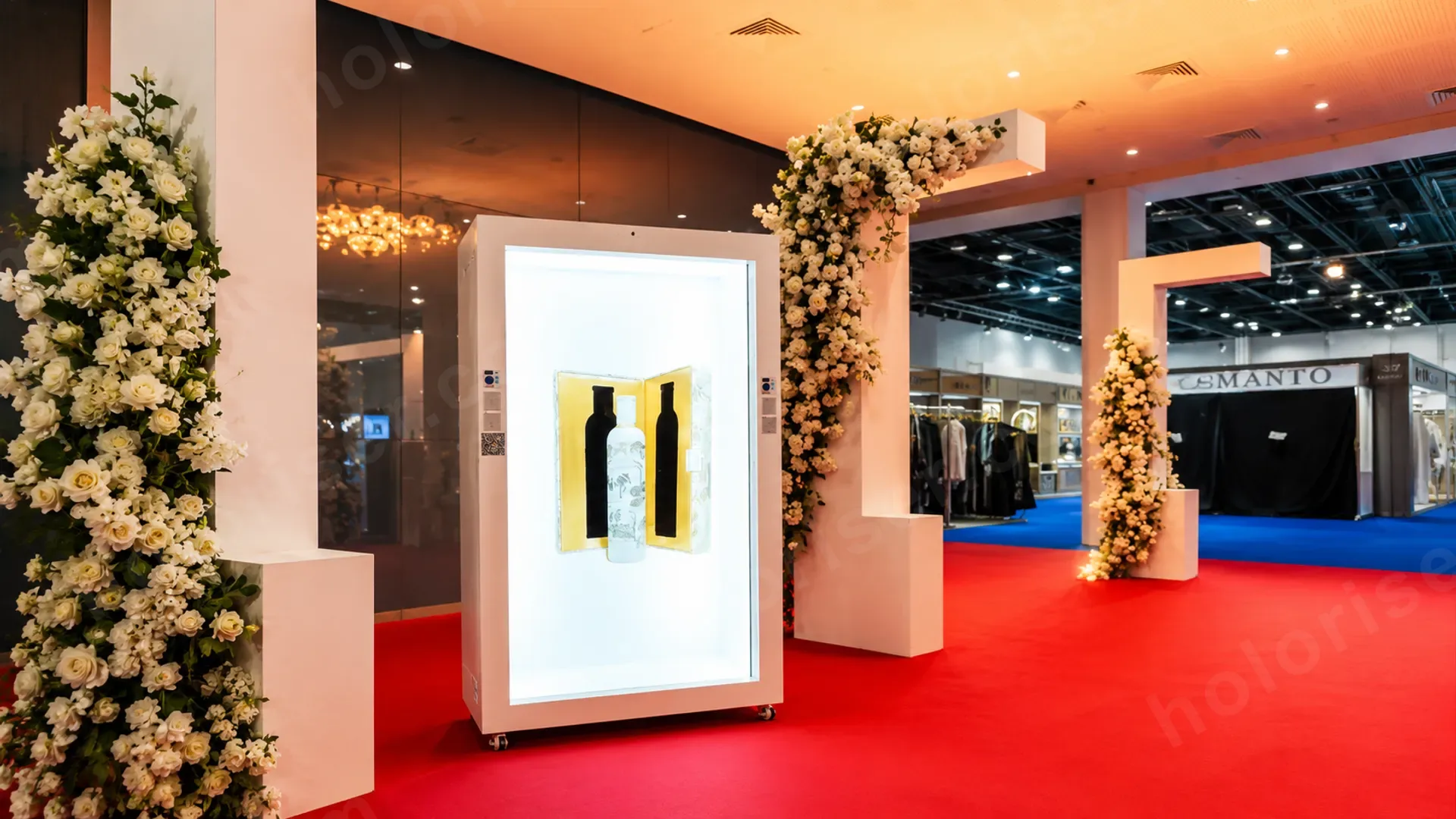
In practice it means a 3D image or a life-size person shown inside a Holobox, the HoloRiser display cabinet. The Holobox comes in 65", 75" and 86" sizes and uses a transparent screen with depth and lighting inside the cabinet, so the content looks like an object or a person standing in the box rather than a picture on a flat screen. Students and visitors see it together, without headsets.
That last point matters for education. A group of twenty can stand around one Holobox and discuss what they see. VR, which is a separate HoloRiser service, gives one person full immersion at a time. Both are useful, for different jobs.
3D hologram medical training: anatomy a whole class can see
Anatomy is the clearest case for 3D. The structures are spatial, and students have to build a mental model of how organs sit relative to each other.
The research backs this up, with some nuance. A meta-analysis by Yammine and Violato covering 36 studies and 2,226 participants found that 3D visualisation technologies gave a small improvement in factual anatomy knowledge and a moderate improvement in spatial knowledge, compared with other teaching methods (Anatomical Sciences Education). A later meta-analysis by Bogomolova and colleagues in Medical Education found that seeing depth helped learning when the 3D model was interactive, but not when students only looked at fixed images. The lesson: a rotating, explorable model beats a 3D video loop.
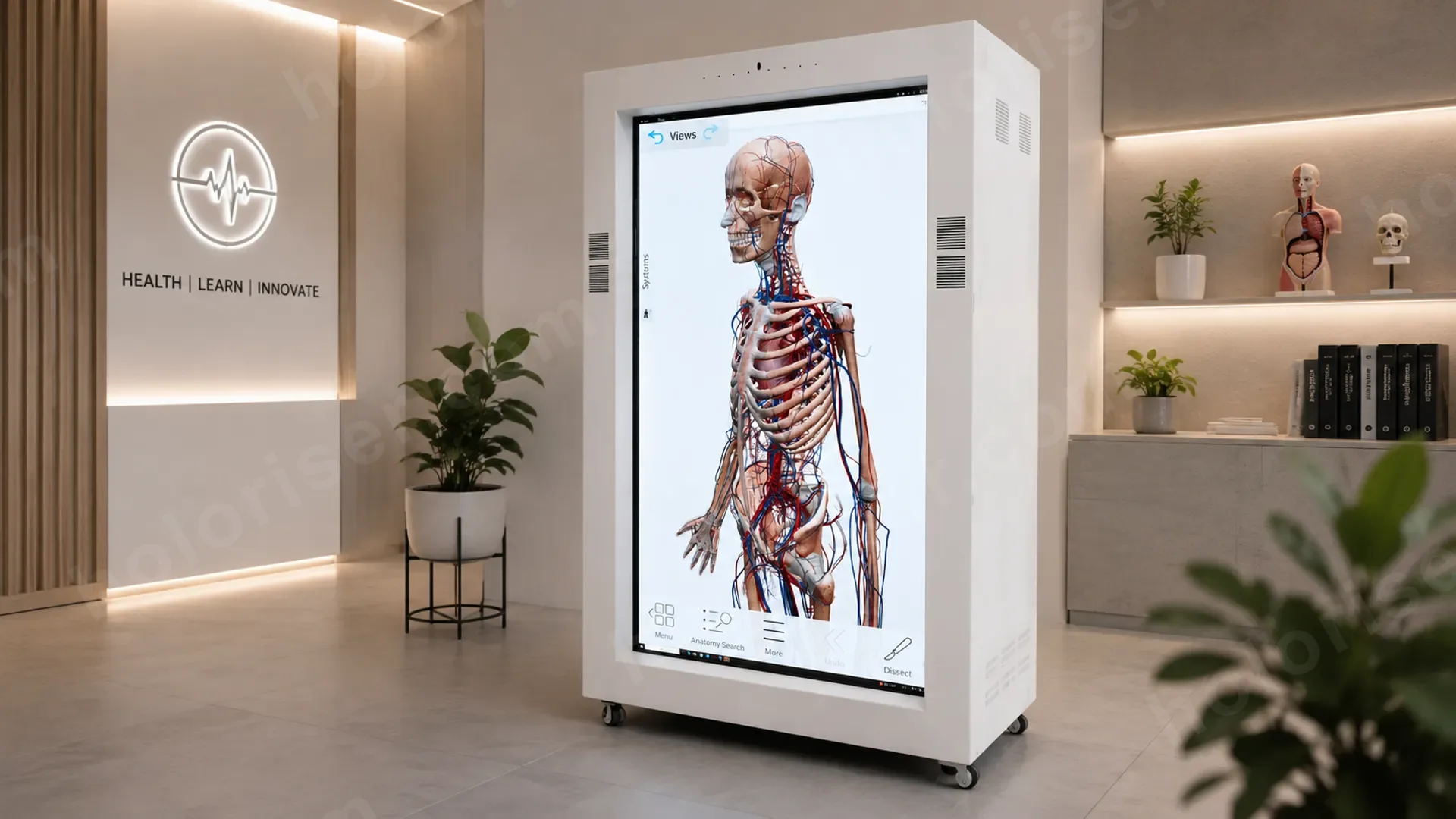
We built exactly this kind of setup. In our 3D Medical Education on Holobox project, specialised medical software shows the full human body inside the Holobox, with anatomy detail approved by a medical partner. Trainers can bring up organs and body systems one by one, and students see the model at close to real size in front of them instead of on a textbook page.
It doesn't replace a dissection lab or clinical practice. It sits between the textbook and the lab, as a shared display a lecturer can teach from, and as a stand for medical exhibitions and training centres.
For individual practice, such as walking through a procedure step by step, VR is usually the better fit. Universities in the UAE already use it: in February 2023 the American University in Dubai announced what it described as the first fully immersive undergraduate VR laboratory course in the UAE, where biology students explore an anatomically accurate 3D model of the human body (AUD). This is the "educational VR UAE" use case in its simplest form. Our AR and VR services in Dubai cover this side.
Universities: guest lecturers without the flight
The second strong use case is telepresence: a lecturer appears at life size in the room while actually being in another city or country.
The best documented example is Loughborough University in the UK. In September 2025 it described itself as the first UK university to bring hologram-style displays into student learning, when a researcher from the University of Vaasa in Finland was beamed into a lecture, and it now runs two life-size units plus two smaller ones (Loughborough University). A small study of 12 students who attended lectures given this way, by Burnett, Locke and colleagues, reported a strong sense that the speaker was "in the room", with some evidence of distraction. In other words, it works best when the novelty is managed and the lecture is planned for the format.
We've run the same idea on a Holobox in the UAE. In September 2026, at a scientific meeting in Abu Dhabi, a speaker appeared at life size inside a Holobox on stage while actually being in Toronto, Canada, in front of a room of doctors. For a university, the same setup brings in a visiting professor from Riyadh, Cairo or London for a guest session, a thesis panel or an open day. The requirements are practical: a stable connection at both ends, the speaker filmed full-body against a plain background, a rehearsal, and a recorded backup. We cover the details in Putting a Remote Keynote Speaker on a Dubai Stage as a Hologram.
On campus, the Holobox also works as an AI ambassador at open days, answering prospective students' questions about programmes and admissions in Arabic and English from content the university has approved.
Museums: a guide that speaks every visitor's language
UAE museums are already leaning into this. Abu Dhabi's Zayed National Museum, which opened to the public on 3 December 2025, uses holograms and interactive exhibits across its galleries, according to Gulf News. In May 2026 Dubai Culture and DIFC announced a five-floor Museum of Digital Art with a "digital twin" model for global access.
For a hologram museum in Dubai or a heritage gallery anywhere in the UAE, a Holobox does two jobs:
- Show the object. A fragile manuscript, a dhow, a falcon or an archaeological piece is shown as a 3D model inside the box, so visitors can see details that would otherwise sit behind glass.
- Tell the story. A life-size AI guide stands beside the exhibit and answers visitors' questions in several languages, using only the content the museum has approved. It doesn't invent dates or attributions, because it answers from the curators' text.
We've built this kind of character for children. For Fujairah Environment Authority we turned their cartoon character Marjan into an AI-powered 3D version on a 75" Holobox, who tells stories, shares facts in simple language and answers children's questions in several languages. The same approach suits a museum's school programme. How these characters are built is explained in AI Hologram Avatars: How a Talking 3D Character Is Built.
Holobox or VR: which one for your programme?
- Group teaching or a gallery: Holobox. Many people see the same 3D content at once, with no headsets to clean or queue for.
- Individual practice and immersion: VR. One learner, full attention, ideal for procedure rehearsal or a virtual site visit. Read When AR and VR Earn Their Place for the throughput maths.
- A remote lecturer: Holobox with a live stream.
- Visitor questions in several languages: Holobox with an AI guide working from approved content.
- Content updates: both are updated in software. With a Holobox, a new 3D model or a new script can be loaded without changing the hardware.
Before you start
- Define the learning goal first. "Students can identify the chambers of the heart" is a brief. "We want holograms" is not.
- Plan the content source. Medical models need a medical partner's sign-off. Museum guides need the curators' approved text.
- Make it interactive. The research above is clear that explorable 3D teaches better than a passive loop.
- Pick the size for the room. A 65" fits a classroom corner or a gallery niche. A 75" or 86" shows a person or a full body at close to real size. See Holobox Sizes and Installation.
- Decide who updates it. A lecturer or curator should be able to change content without calling a technician.
The takeaway
Hologram education in the UAE works when it fixes a specific problem: 3D anatomy a whole class can see, a lecturer who can't travel, or a guide that answers every visitor in their language. VR covers the cases where one learner needs full immersion.
You can explore our hologram in Dubai solutions or see how we work with schools and universities on the education industry page. If you run a museum, a university or a training centre, tell us what you teach, to whom, and in which space, and we'll suggest the right setup.