Putting a Remote Keynote Speaker on a Dubai Stage as a Hologram
What the capture room and the stage each have to give you before a live holographic speaker holds up, and when a recorded version is the better call.
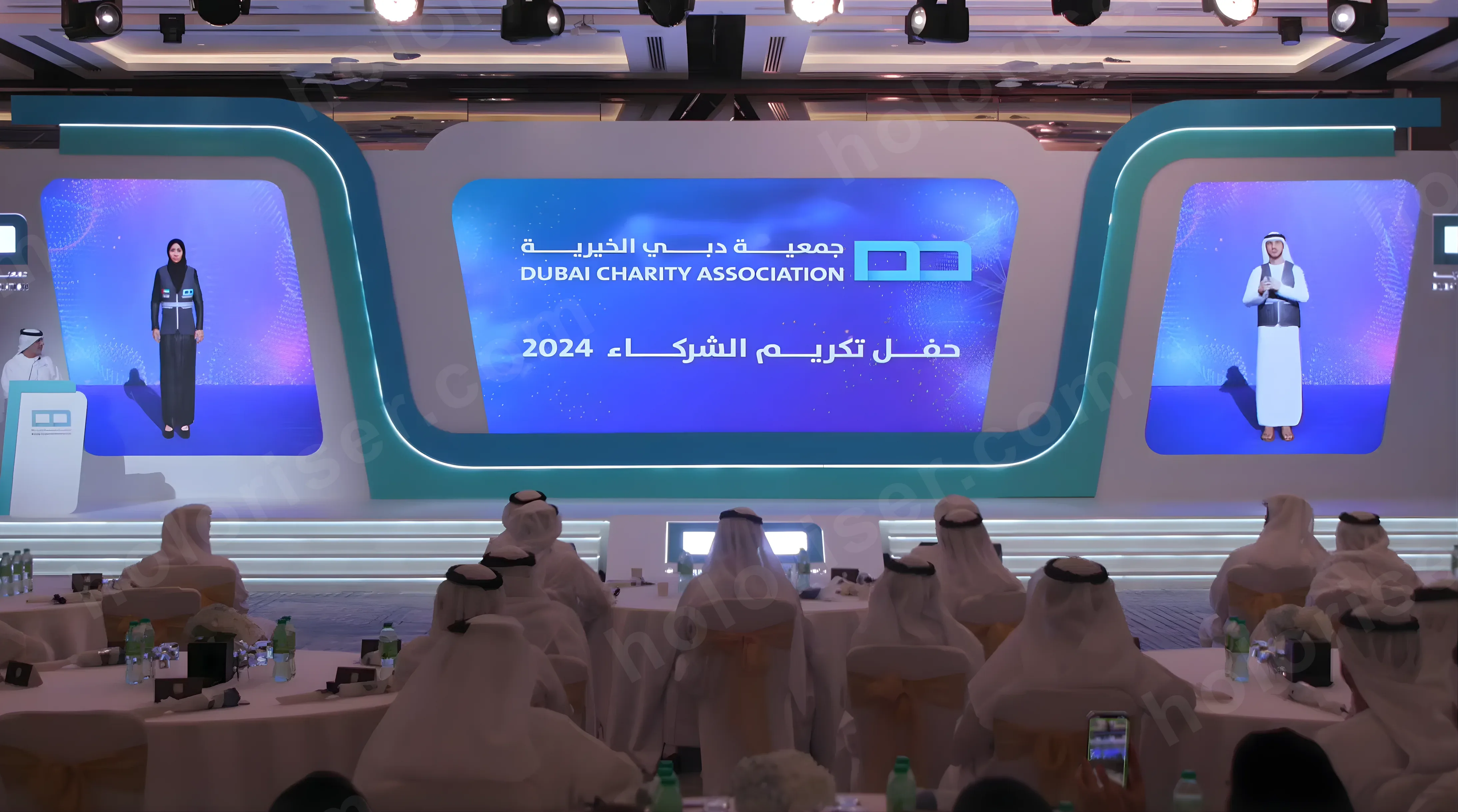
Your keynote cannot fly. The visa came late, or they will not do fourteen hours in the air for a forty-minute talk. You are three weeks out from a conference in a Dubai ballroom and somebody in the production meeting says the word hologram.
That is usually when we get the call. Here is what the segment needs, in the order you have to decide it.
The capture room decides most of it
A stage hologram works because the projection surface only shows bright pixels. Black reads as nothing. So whatever sits behind your speaker has to arrive at the venue as genuine black: a matte backdrop with no spill on it, and enough rim light from above and behind that the speaker does not sink into it. Wardrobe follows the same rule: a black jacket dissolves at the shoulders and leaves you a floating head, so put them in deep grey or navy, and tell them weeks out rather than on the morning.
Then match the lighting to your stage. If the show look is warm and keyed from a front truss while the capture room is flat and cool, the audience reads a cut-out pasted onto the stage. Send the capture crew your lighting plot and a photo of the stage under show conditions, and have them match key direction and colour temperature. Fifteen minutes of that conversation carries the illusion.
Camera height is the other common mistake. Put the lens on the speaker's eye line, at a distance that matches how far they will appear to stand from the front row. A tripod at chest height makes a life-size figure address the carpet. Frame the full body with room to move, and get them off the lectern, because a speaker behind a podium reads as a video call with extra steps.
The uplink, and what latency really does
Hotel wi-fi is not a broadcast path. Plan for a hardware encoder and a dedicated wired line, with a bonded cellular backup on a different carrier. Budget 12 to 20 Mbps of clean upload with headroom, and measure it at the hour of the talk rather than at 3pm on a Tuesday.
On a good path with SRT we plan around 300 to 600 milliseconds one way. Add the return feed the speaker needs, program video plus room audio so they can hear a laugh and know when to stop, and the round trip roughly doubles. That is fine for delivered content and uncomfortable for a fast exchange.
Drift is the part nobody expects. When the network gets noisy the jitter buffer grows to protect the picture and does not shrink back quickly, so your 500 milliseconds becomes 900 by minute twenty. The image still looks perfect. The gaps in conversation just get longer and stranger. Brief the moderator to ask one question, then wait, visibly, without filling the silence. And settle before the production meeting ends what happens if the link drops: a held frame and one scripted line for the moderator.
What the stage has to give up
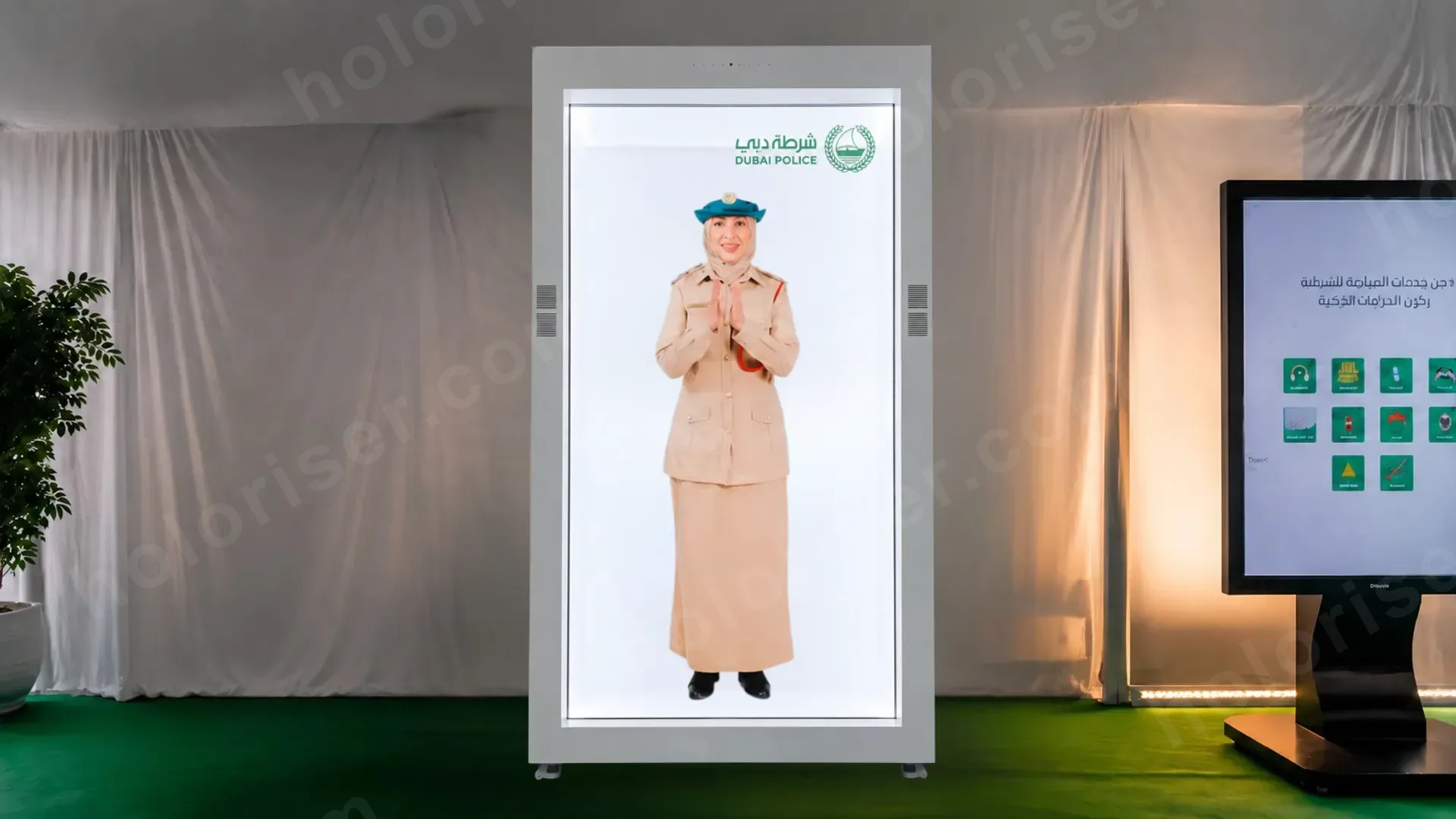
The image lands on a tensioned foil or a holographic mesh hung across the front of the stage, fed by a projector on the deck or overhead. Two things follow from that geometry.
Depth first. A life-size figure needs the projection plane far enough downstage for the image to land at the right size, then black space behind it. On a typical UAE ballroom stage we ask for four to six metres of usable depth behind the foil line, plus the projector throw. Shallow raised stages and small meeting rooms do not have it, and you learn that on a site visit rather than from a PDF floor plan.
Darkness second. Anything lit behind the foil shows through it: the back wall, the upstage cyc, the LED wall you were going to run branding on, any wash that spills past the speaker's mark. Your lighting designer loses the back half of the stage for the length of the segment. Treat it as a lighting state rather than a video source and the rest of the design falls into place.
Where the audience has to sit
The foil is invisible inside a viewing cone and obvious outside it. Plan for roughly 30 to 40 degrees off centre before the edge of the material or a reflection off the deck starts to show. Outside that cone people see a sheet of film with a picture on it, which is worse than a plain screen.
Mark the cone on the venue's seating plan before you sell a seat, then deal with what falls outside: pull the outer seats of the far side blocks for standing press, or angle the block inward. Your cameras belong inside the cone too, so put the main one dead centre at the back.
Rehearsal is where it is decided
Book a full technical day on site with the foil rigged and the show lighting in its real cue state. None of this can be checked in a meeting room the week before.
Run the link test separately, with the speaker on the connection they will actually use, at the hour they will actually be on. A trial from their home office on a Wednesday afternoon tells you almost nothing about a Thursday at 1am from an office building where the IT team throttles upload after hours.
A 9am keynote in Dubai is 1am in New York and about 10pm the previous evening in Los Angeles. Treat that as a performance detail as much as a scheduling one, and put a local crew and producer at the speaker's end.
The cheaper version, and it is usually the right one
Record the talk in a studio. You control the backdrop, the lighting, the wardrobe and the eye line, and you can do a second take. The file arrives days early, gets graded to match your stage, and plays from the media server on timecode. No network, no drift, nobody awake at 1am.
What you give up is reaction. A recorded speaker cannot answer the question from row four, and cannot mention the minister who spoke before them or the number announced that morning. Audiences notice, especially rooms full of people who attend conferences for a living.
Two ways to claw most of that back:
- Script one or two references into the recording that only make sense on the day: the event name, or something the client can guarantee will be said.
- Play the recorded hologram, then bring the speaker in live on a conventional screen for the Q&A. The audience gets presence and interaction, and the fragile part of your show is ten minutes long instead of forty.
A third route is to build the person as a rendered character rather than film them. For Fujairah Digital Government at GITEX 2025 we built a bilingual host from footage of one of their own staff, with an admin panel the client used to approve every question. For SHRM MENA 25 in Dubai we modelled a 3D character of Khalid Al-Harbi who welcomed visitors and ran the session. Both were Holobox experiences rather than main-stage projections, but the production question is identical: how much of this person's performance can you settle before the doors open?
When the live link is worth the risk
Live earns its place when the speaker's reaction is the content. Cases where we would argue for it:
- An opening address that has to respond to something announced minutes earlier.
- A launch where a live figure, a signature or a reveal has to happen in the room.
- A real Q&A in front of an audience that will ask hard questions and would spot a canned answer.
- A speaker whose presence is itself the story, where a recorded message reads as less commitment than turning up.
If none of those apply to your segment, record it and sleep.
If a speaker slot on your agenda is looking difficult, we can walk the room and tell you what will hold. Our stage hologram work and what we build for conferences and live events starts from the venue and the running order. Send us the floor plan and the schedule and we will come back with a cost and what the segment needs from your stage.