Hologram in Dubai: Which Technology Fits Your Event?
Holobox, stage hologram, hologram fan or AR? A practical guide to choosing the right hologram technology in Dubai by venue, audience and goal.
We get the same request almost every week, worded differently: "We want a hologram on the stand." "We want someone to appear as a hologram on stage." "We want something floating in the air."
In Dubai, "hologram" now covers four quite different technologies, each with its own conditions and limits. Picking the wrong one rarely gives you a slightly weaker result. More often it gives you an experience half the audience can't see.
Here is a short guide to what people usually mean by "hologram", and when each option is the right one.
First, ask where it will stand
Before talking technology, three questions settle most of the decision:
- Is the space lit or dark? A fully lit exhibition hall is a completely different problem from a conference room with the house lights down.
- Where will people watch from? Visitors walking past a stand from every direction, or an audience seated in front of a stage?
- What should happen in front of it? Is it enough for people to watch, or should they talk to it, ask questions and get answers?
Holobox: a life-size person inside a box
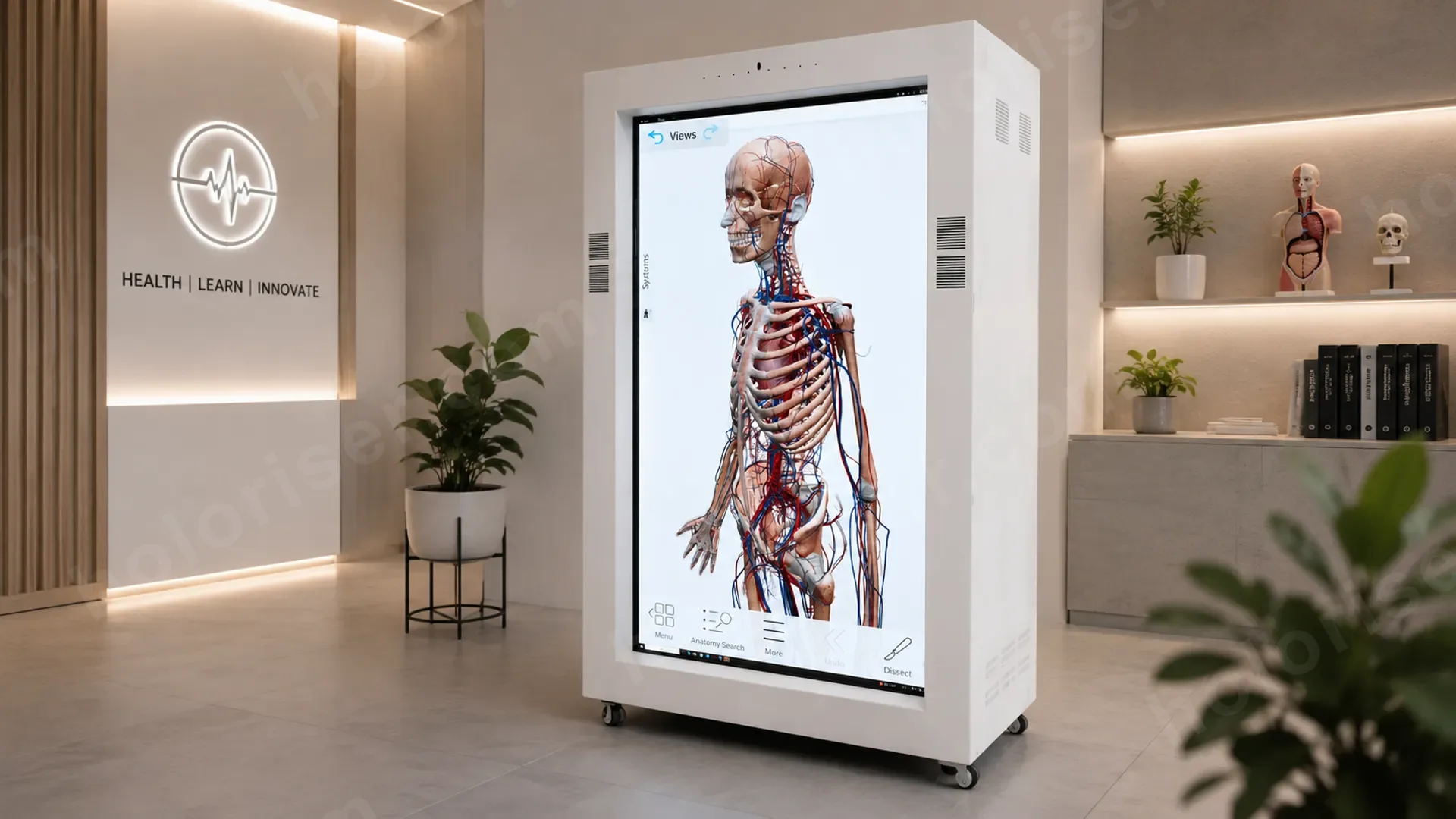
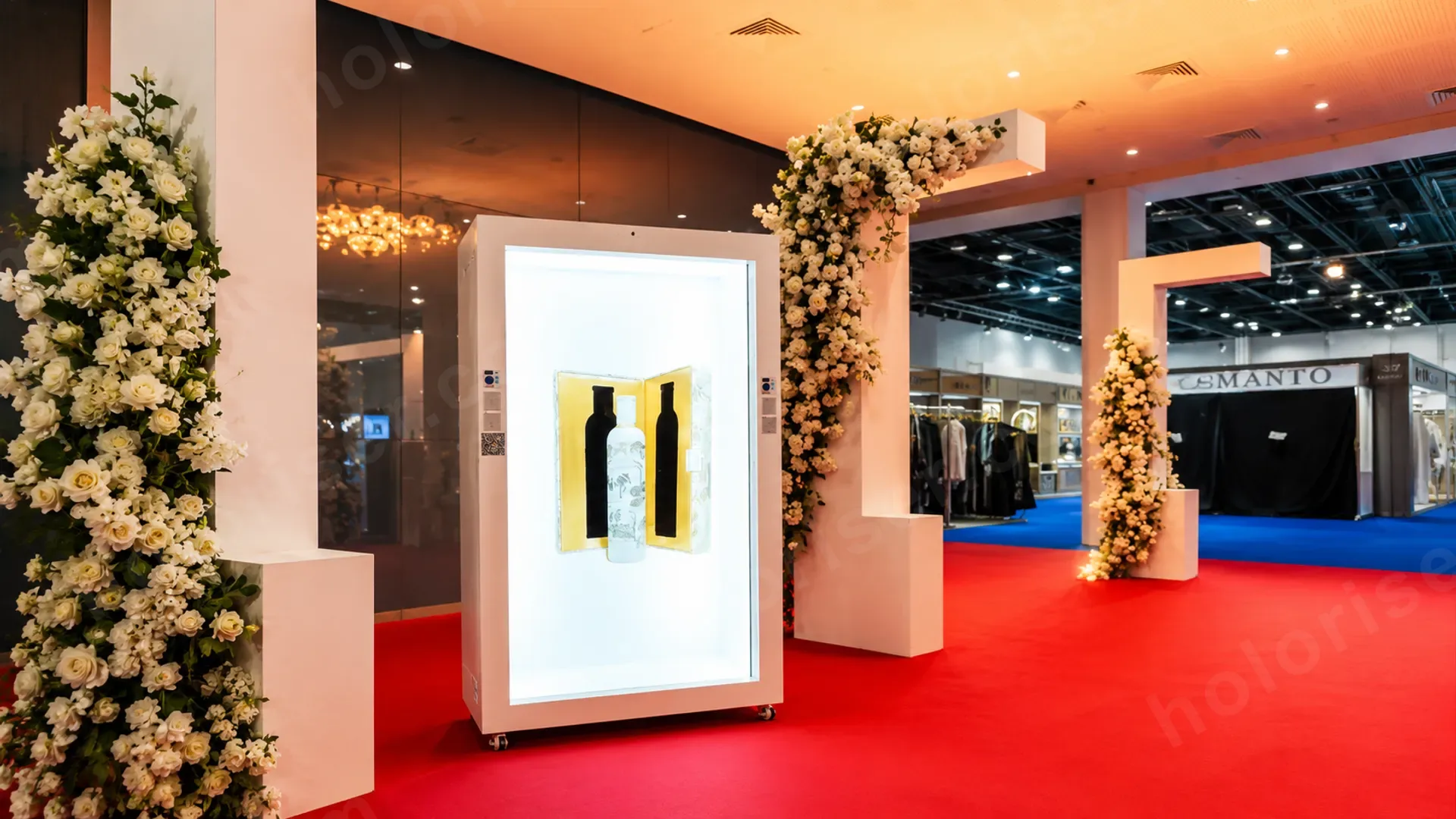
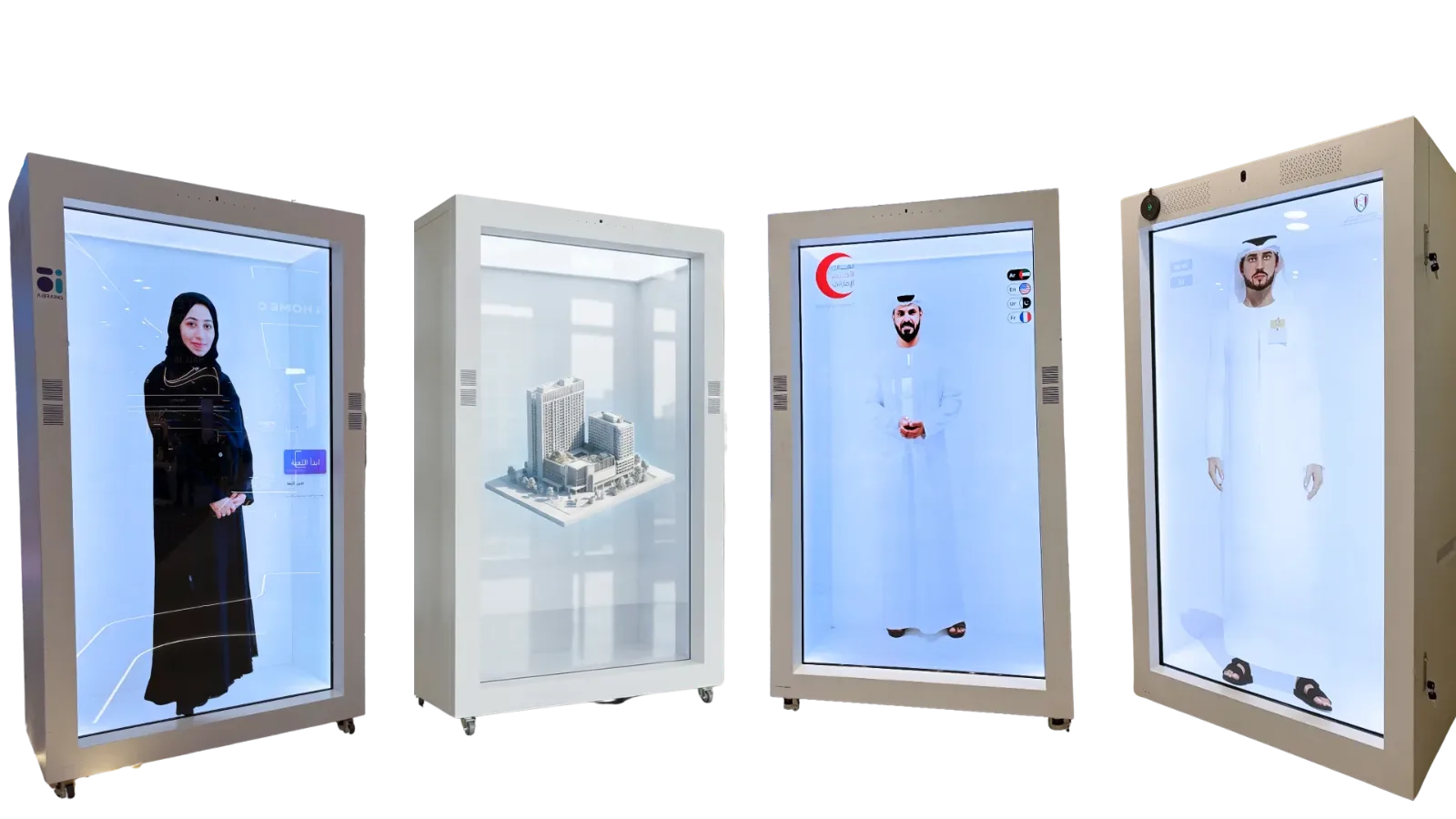
A Holobox is a cabinet with a transparent display and a lit interior. Inside it, a person or product appears at life size with a clear sense of depth.
Its biggest advantage is that it works in the space as it is: no dark room, no stage, no foil rig.
Put it on a stand, in a lobby or in a service centre, and it runs all day.
This is where holograms in the UAE moved from visual effect to service tool.
Connect a Holobox to an AI character and it becomes a virtual member of staff that answers questions.
For Dubai Charity Association we built "Ahmed", a 3D assistant with Emirati features on a 75" Holobox.
He answers visitors from approved data only, in Arabic, English and Hindi. For the Ministry of Justice in Abu Dhabi we designed "Khalid" on an 86" Holobox.
He explains workers' rights in four languages, and the project won first place at the UAE Hackathon at TDRA.
Good for: exhibition stands, customer service centres, lobbies, interactive assistants, 3D product showcases.
Not good for: a large seated audience dozens of metres away.
For sizes and details see our holographic display solutions page.
If your event runs for a few days only, see hologram rental in Dubai.
Stage hologram: a speaker in front of a full hall
When the audience is seated in front of a stage, the answer is a stage hologram.
A transparent foil is stretched across the front of the stage, a projector throws the image onto it, and the speaker appears standing on stage at life size.
Done well, it is striking. But it puts demands on the venue: enough depth behind the foil line, full darkness across the back half of the stage, and a limited viewing angle that has to be drawn on the seating plan before tickets go on sale.
We cover these conditions in detail in Putting a Remote Keynote Speaker on a Dubai Stage as a Hologram.
Good for: conference keynotes, launches, gala evenings.
Not good for: open stands and brightly lit spaces.
Hologram fans: an image floating in the air
A hologram fan is a set of LED blades spinning fast enough that the image seems to hang in the air.
It is relatively affordable and easy to install, and it works well for a logo, a product or a short animation that catches the eye from a distance.
Its limits are just as clear. The image reads best from the front. The spinning blades need a protective cover anywhere the public can reach.
And it can't show a life-size person holding a conversation. It is a tool for attention, not for dialogue.
AR and VR: the hologram on the visitor's screen
Sometimes the project needs no physical display at all. Augmented reality places a 3D model on the visitor's phone screen, on top of the real space.
Virtual reality takes them somewhere else entirely through a headset. Technically neither is a hologram, but both are often requested under that name.
They fit when you want visitors to take the experience with them, or walk through a project that hasn't been built yet.
The short version
- A virtual staff member talking to visitors in a lit space? Holobox with an AI character.
- A speaker appearing in front of a seated hall? Stage hologram.
- A floating logo or product to stop people walking past? Hologram fan.
- A personal experience on the visitor's phone or in a headset? AR or VR.
What actually drives the cost
The hardware is only part of the picture. What usually moves the cost up or down is the content.
Is it a filmed person or a 3D character you build? Fixed content on a loop, or an AI character that answers questions? How long does it run, and does it need a crew on site for the whole event?
That is why a hologram quote means little until we know where it will stand and who will stand in front of it.
How we start
Send us a short description of the space, the audience and what should happen in front of the experience.
We will recommend the right technology and set up a live Holobox demo before you commit to anything.
We have delivered more than 50 installations for government and private clients across the UAE.
See our case studies for how each technology worked in practice.