How UAE Government Entities Are Using Holographic Presenters
Dubai Police, Civil Defense, the Ministry of Justice and the UAE Red Crescent have all put a holographic presenter in front of the public. Here is what a government comms team has to settle first: languages, approvals, staffing, and the difference from a kiosk.
A government stand at GITEX has a few seconds to earn a visitor's attention. A service point inside a public building has the opposite problem: people arrive already unsure what to ask for.
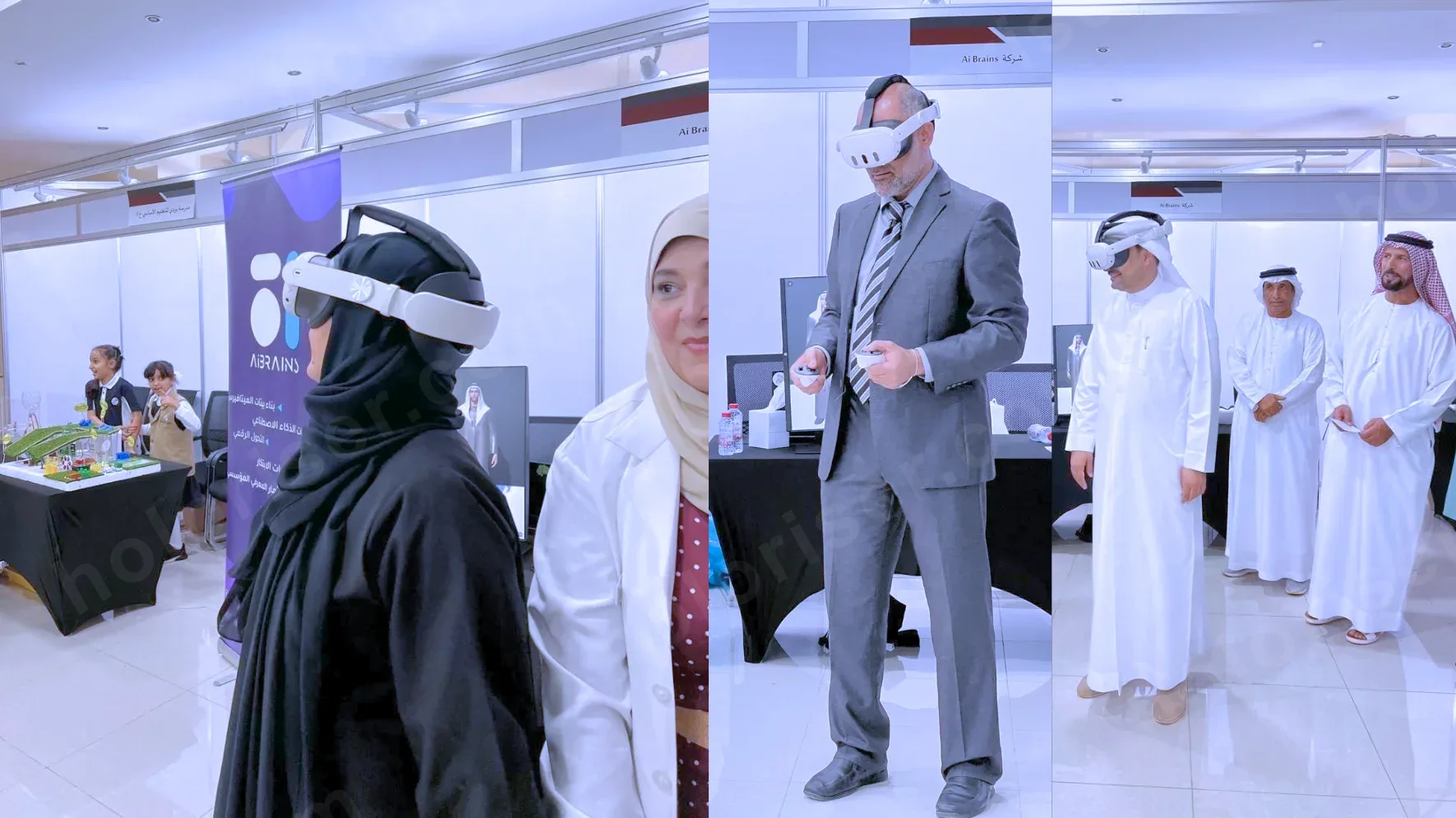
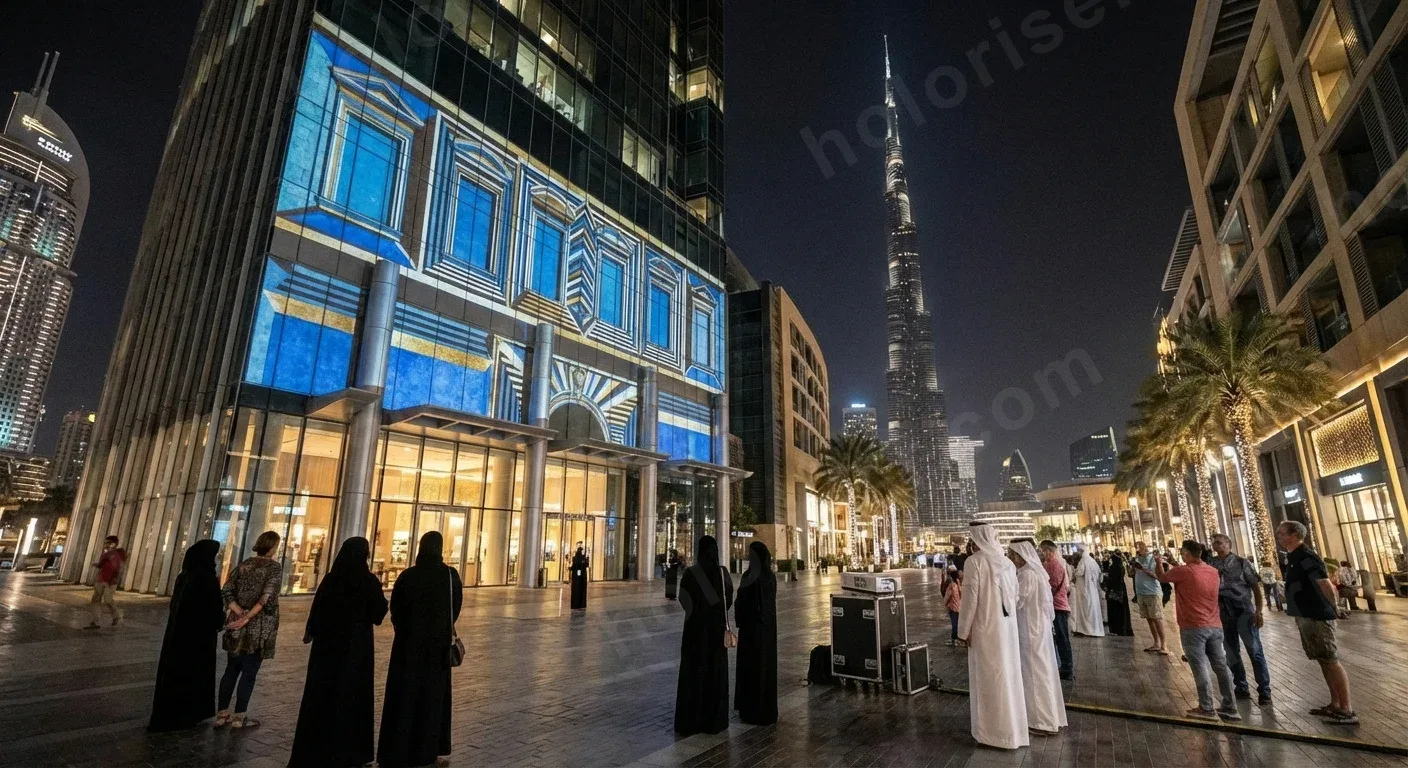
We have built holographic presenters for both situations. Dubai Police, Civil Defense, the Ministry of Justice in Abu Dhabi, the UAE Red Crescent, Fujairah Digital Government and Fujairah Human Resources have each put a character on a Holobox in front of the public. The questions that come up in the first meeting are rarely about the hologram. They are about languages, approvals, who has to stand next to the thing, and what happens on day three of an event.
Here is how those questions got answered on real jobs.
What has actually been deployed
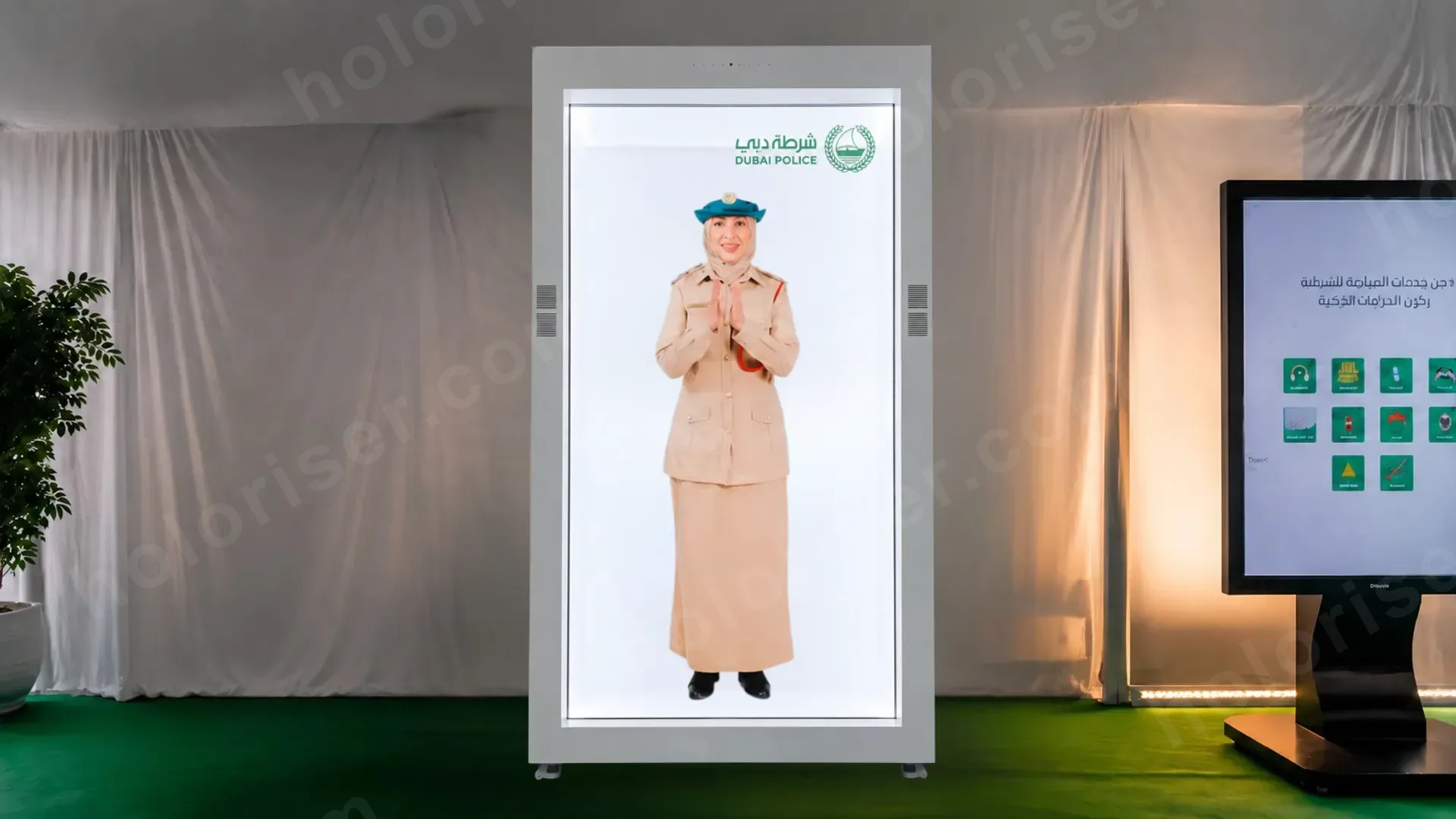
For Dubai Police we built a realistic virtual policewoman from footage of a Dubai Police officer and placed her inside an awareness quiz. She welcomes the visitor, asks safety questions, and shows a score at the end. The visitor selects answers on the Holobox screen itself. We wrote the program with several scenarios so the question set can change with the campaign. It ran at a cycling event, where the questions covered safe behaviour and the key guidelines. The full write-up is in the Dubai Police case study.
Civil Defense went the other way. Tareq, an Emirati virtual firefighter, delivers fire-safety guidance directly. No quiz, no branching, no back-end systems. He presents, and he holds attention at events and public spaces where a printed notice gets walked past.
The Ministry of Justice in Abu Dhabi asked for something that could act, not only inform. Khalid is a 3D assistant for workers' rights on an 86-inch Holobox. He explains rights in Arabic, English, Hindi and Urdu, and the interface carries direct buttons for calling the police, filing a request or report, and reaching labour services. The program is connected to the work and labour reporting system and to a police line, so a worker can start a real process at the device instead of being told where to go next. It took first place at the UAE Hackathon held at TDRA.
The UAE Red Crescent applied the same pattern to giving. Hareb welcomes the visitor, explains the available donation channels, walks through the payment steps on the device, then comes back at the end to thank the donor.
Four entities, four different jobs. Only one of them is a presentation.
A presenter is not a kiosk
A kiosk waits. It shows a home screen and hopes somebody touches it. Every project above starts by speaking first: Hareb greets, the policewoman greets, the virtual host on Fujairah Digital Government's GITEX 2025 stand greets and then runs the quiz. That one difference changes who walks up. Someone who would never touch an idle screen will answer a character that has just said hello.
The second difference is what the visitor has to do. A kiosk assumes you know what you want and can find it in a menu. A presenter can ask. Mozzah at Fujairah Environment Authority and Hamad at Fujairah Human Resources both listen, understand the question and reply by voice, which is a different job from hunting through submenus for the right service page.
Then there is scale. These characters run at roughly human height on the 75-inch and 86-inch Holobox units, so the presenter reads as a person standing in the room rather than a video playing on a wall.
And a character can be re-cast. The same device that carried a road-safety quiz can carry a fire-safety presenter, a donation flow or an HR assistant. The hardware is the least interesting part of the decision.
Languages, and who actually decides them
Arabic and English is where every brief starts. It is not always where it should end.
Khalid speaks four languages because of who he serves. Workers on sites and in workshops in Abu Dhabi are not a bilingual audience, and without Hindi and Urdu a rights service would miss most of the people it exists for. At Dubai Charity Association, Ahmed answers in Arabic, English and Hindi for the same reason. The Fujairah Digital Government quiz ran in Arabic and English because a GITEX stand audience genuinely is bilingual.
Pick the languages from the queue in front of the device, not from the org chart.
Approvals decide your timeline
Government content goes through sign-off. Design for it rather than around it.
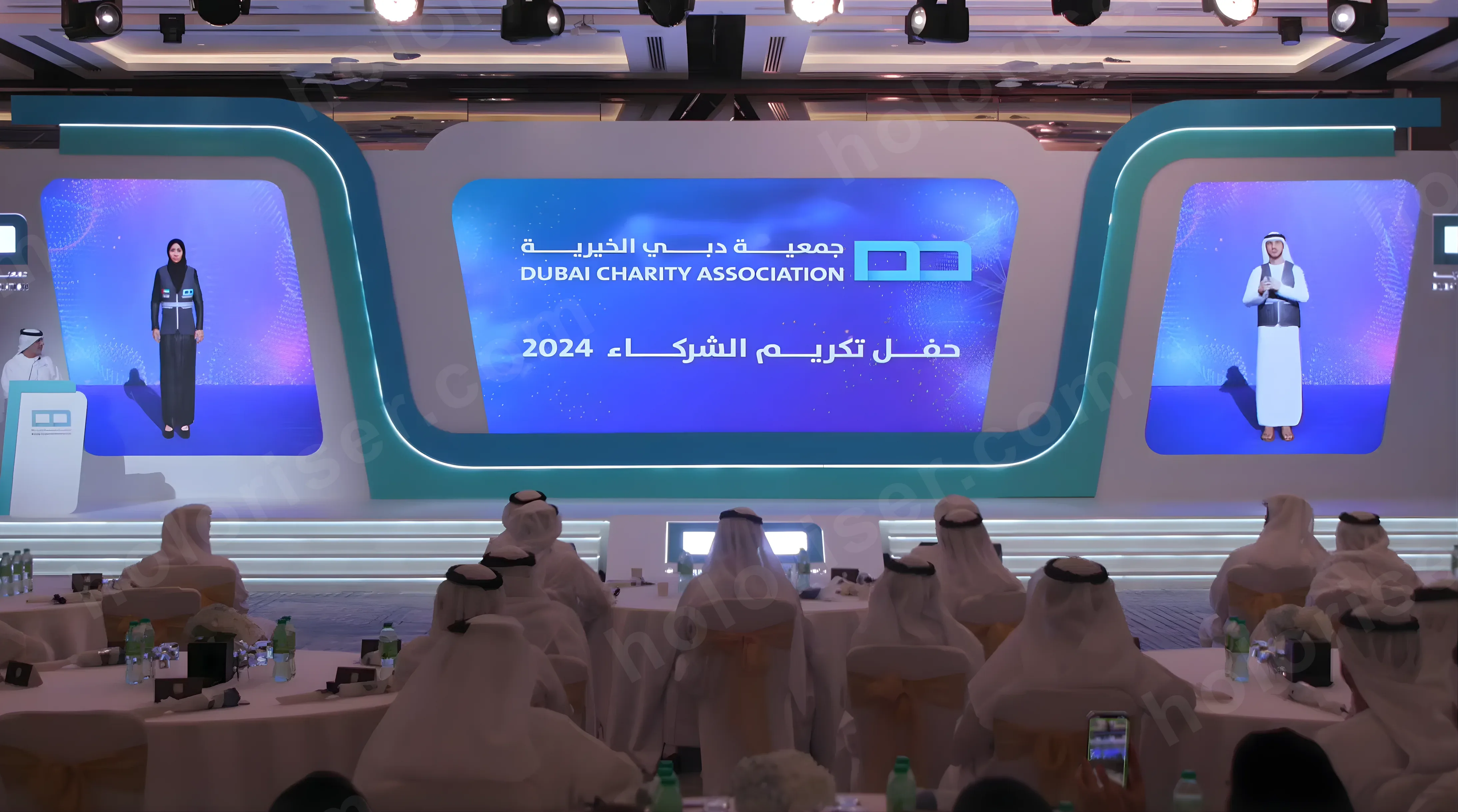
The Fujairah Digital Government quiz has an admin side where the entity's own staff add questions, edit them, review them and approve them. Approved questions move to the display automatically. Nobody has to call us to change a question, and nothing reaches the public that an authorised person has not signed off.
Where the presenter answers freely, the control moves into the data. Ahmed at Dubai Charity Association runs on a retrieval system pointed at the association's approved sources, so his answers come from documents the entity owns. Hamad was trained on Fujairah Human Resources' own data. For a public-facing government presenter that matters more than conversational polish: the character should not be able to answer from anywhere except approved material.
Decide early which of the two you are building. A scripted presenter needs one approval cycle over a fixed set of content. A knowledge-base presenter needs a named owner for the source documents and a process for updating them, which is a longer conversation with legal and comms.
Long days and thin staffing
An awareness stand at a major event runs long hours, and the team on it is usually smaller than the plan assumed. The useful property of these builds is that the interaction needs no facilitator. The Dubai Police quiz is self-serve from the welcome through to the score, with the visitor choosing answers on the screen. At GITEX, the virtual host ran the game while the entity's staff managed the questions from the admin side.
That frees the stand team for the part only a person can do: talking to the visitor who has a real question afterwards.
Two practical notes. Content should be changeable without a site visit, which is exactly what the approval-to-display link at Fujairah Digital Government buys you. And the program should carry more than one scenario, the way the Dubai Police build does, so the same device supports a road-safety message this month and a different campaign next month without a new production cycle.
Accessibility is mostly a content decision
Voice in and voice out is the largest single gain. A visitor who will not read four paragraphs on a screen will listen to a character deliver the same four paragraphs. That is much of why Khalid speaks rather than displays.
Then there is the path to action. Khalid's interface puts the police, a request or report, and labour services on direct buttons. Large targets, short path, no menu tree. If someone arrives distressed or in a hurry, the number of taps between them and the right department is the whole design.
Two things are worth checking on site rather than on a drawing: that touch targets sit within reach of someone in a wheelchair, and that the character's audio carries over hall noise without being shouted. Both are cheap to fix during the build and expensive to fix after installation.
What to settle before you brief anyone
Five questions decide the shape of the build.
- Who is standing in front of it, and in which language do they think?
- Does it only tell, or does it need to do something: take a donation, file a report, place a call?
- Scripted content, or an approved knowledge base?
- Who signs off, and how fast can they sign off again when the message changes?
- Where does the unit live after the event? A device that goes back into a store room has a far worse cost per interaction than one that moves to a service centre reception.
Answer those and the technical side is straightforward. Get them wrong and you have a very good-looking character answering the wrong questions in the wrong language.
If you are scoping something for a UAE entity, our government work is here. Send us the brief with the audience, the languages and the dates, and we will come back with a concept and a cost.